
Artificial intelligence is changing how quickly brands can make advertising decisions. AI-powered platforms can adjust bids, shift budgets, change audience targeting, and respond to campaign performance in near real time. Decisions that once required hours of analysis and manual changes can now happen automatically.
This speed creates opportunities to improve media performance, reduce wasted spend, and respond to changes in consumer demand, but it also creates new risks. Automated systems can make decisions faster than marketing teams can review them, sometimes using performance signals that don’t reflect broader business goals.
Without clear rules, AI may direct spending toward short-term results, shift budgets away from strategic priorities, or continue making changes when underlying data is incomplete or inaccurate.
In this white paper, we’ll address how effective AI governance allows brands to benefit from faster media optimization while retaining control over how decisions are made, when human approval is required, and what happens when something goes wrong.
How AI Is Changing Real-Time Media Optimization
Traditional media optimization often depends on scheduled reporting, manual reviews, and campaign adjustments made by media teams. AI reduces the time between identifying a change in performance and taking action.
Rather than waiting for the next campaign review, automated systems can evaluate new information and adjust delivery throughout the day. This allows campaigns to respond quickly to changes that might otherwise go unnoticed.
What Can AI Optimize in Real Time?
AI-powered media platforms can support several types of campaign decisions.
- Bid adjustments: Increase or decrease bids based on predicted conversion value, competition, and other available signals.
- Budget pacing: Adjust spending to stay on track with campaign goals or respond to changes in demand.
- Audience targeting: Change delivery based on predicted audience response and campaign objectives.
- Creative selection: Prioritize ads or creative variations based on observed performance.
- Campaign delivery: Adjust when, where, and how frequently ads appear within platform settings.
The exact level of control will vary by platform. Some tools provide detailed settings, while others make decisions within automated systems that offer limited visibility.
These differences affect how automated decisions should be managed. Brands must understand which settings they can control directly, which decisions can be monitored, and where additional oversight is necessary.
Why Faster Optimization Requires Better Governance
AI generally optimizes toward the objectives and signals it receives. If a campaign is designed to generate conversions at the lowest possible cost, the system may favor audiences or placements that produce inexpensive conversions.
That result may look successful in a platform report without delivering the strongest business outcome. For example, an automated campaign might direct more spending toward existing customers who are already likely to purchase. While this could improve reported return on ad spend, it may be less likely to attract new customers or generate incremental sales.
Faster optimization also means that mistakes can spread quickly. A data issue, incorrect campaign setting, or poorly defined objective can influence many automated decisions before a team notices the problem. Governance provides the boundaries needed to keep decisions aligned with business goals.
The Risks of AI Optimization Without Clear Controls
The risks of automated media optimization often come from the way AI is configured, the information it receives, and the authority it has to make changes. These risks generally fall into three main categories.
Budget Changes That Exceed Business Limits
AI may identify opportunities to increase spending or move budgets toward campaigns showing stronger results. However, those recommendations may conflict with financial limits, contractual commitments, or planned investments. A system could favor one product, region, or channel while reducing support for another that is important to the business.
Budget controls should account for more than total campaign spend. They may also need to address daily pacing, maximum budget changes, market priorities, and minimum investments in specific campaigns. Advertisers should define these limits before allowing automated systems to make spending decisions.
Optimizing for the Wrong Performance Signals
AI is only as useful as the goals and data guiding its decisions. Many advertising platforms optimize using the conversion data and performance metrics available within their own systems. These signals can help manage campaigns, but they may not fully reflect incremental sales, customer value, or profit.
For example, a campaign generating a high volume of low-value purchases may appear stronger than one attracting fewer customers with greater long-term value. Brands should establish which business outcomes matter most and identify where platform metrics need to be supported by independent measurement.
The objective is to make sure AI is improving business performance rather than simply improving the metrics it has been instructed to maximize.
Brand Safety, Privacy, and Compliance Risks
Automated systems can also introduce risks involving ad placement, audience selection, data use, and messaging. A campaign may reach audiences that should be excluded, appear alongside unsuitable content, or use targeting settings that conflict with brand or regulatory requirements.
These risks are especially important for brands operating in regulated industries or across markets with different privacy rules. Governance should define approved audiences, placement exclusions, data restrictions, creative requirements, and escalation procedures. These controls should stay in place even when automated systems are making rapid adjustments.
Building an AI Governance Framework for Real-Time Media
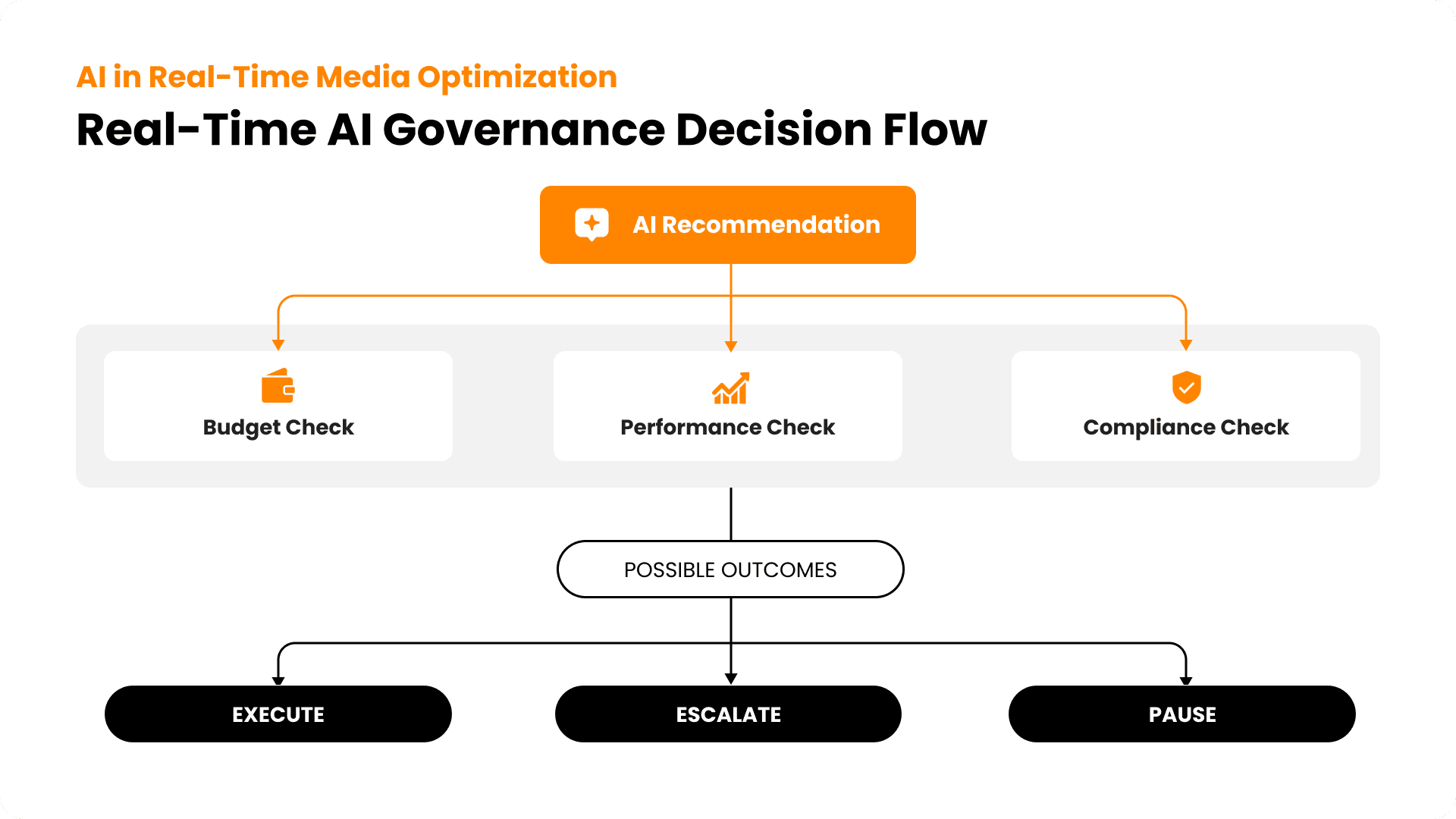
An effective governance framework starts by defining what AI is allowed to do, how much authority it has, and who is responsible for its decisions. The framework should be practical enough to support daily media operations without requiring human approval for every minor change.
Define Which Decisions AI Can Make
Not every optimization decision carries the same level of risk. Small bid adjustments within approved limits may be suitable for automation. A major budget shift between channels, however, could affect campaign commitments, brand priorities, or revenue forecasts.
Brands should classify decisions based on their potential financial and business impact. For each type of decision, establish whether AI can act independently, operate under human supervision, or provide a recommendation that requires approval.
These rules should reflect the capabilities of the media platforms and tools being used. Where a platform does not support direct approval controls, brands may need to limit automation settings or rely on monitoring and manual intervention.
Establish Clear Budget and Performance Guardrails
Guardrails define the limits within which automated systems can operate. These may include maximum daily spend, limits on budget changes, approved audience and geographic settings, performance thresholds, and restrictions on campaign modifications.
For example, a brand might permit automated bid changes within an approved range but require review before increasing a campaign budget beyond an established amount.
Performance rules should also reflect business context. A temporary increase in acquisition costs during a major product launch may be acceptable, while the same increase during a stable campaign could require investigation. The goal is to create rules that support the campaign strategy rather than relying on applying a fixed set of limits to every situation.
Assign Ownership and Approval Authority
AI governance requires clear accountability. Media teams may manage daily campaign settings, while marketing leaders approve major budget changes. Finance teams may set spending limits, and legal or compliance teams may oversee restrictions related to audiences, data, and messaging. Each team should understand its responsibilities before automation is expanded.
Brands should document who can approve changes, who monitors performance, who responds to alerts, and who has authority to pause automated activity. When responsibilities are unclear, important warnings can be overlooked or decisions can be delayed.
Build Alerts and Intervention Rules
Even well-configured systems can encounter unexpected conditions. Brands need a defined process for identifying and responding to problems such as unusual spending increases, sudden performance declines, tracking failures, or changes in campaign delivery.
Alerts should distinguish between issues that require immediate action and those that can wait for scheduled review. High-risk situations may require pausing a campaign, disabling an automated rule, or reverting to previously approved settings. Lower-risk issues may call for further analysis without interrupting delivery.
Intervention procedures should be tested and documented so teams know how to respond when a problem occurs.
How to Balance Automation with Human Oversight
Human oversight doesn’t mean reviewing every automated decision. That would eliminate the speed that makes AI useful. Instead, brands should determine where automation can operate safely and where human judgment provides necessary context.
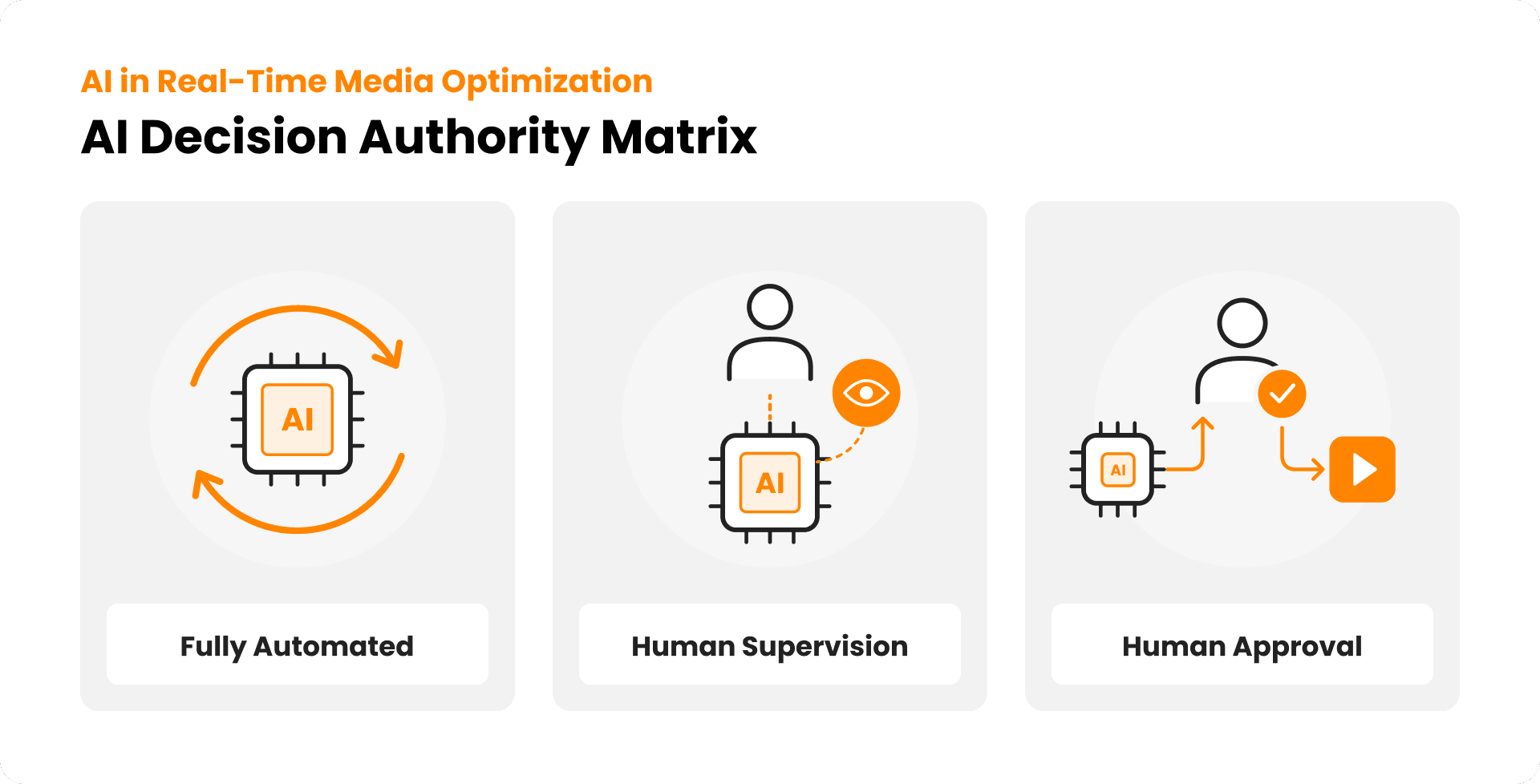
Three Levels of AI Decision-Making
A practical approach is to establish three levels of decision authority.
| Decision Level | How It Works | Example |
| Fully Automated | AI makes approved changes without individual review. | Adjusting bids within established limits. |
| Human-Supervised | AI makes permitted changes while teams monitor results and receive alerts. | Moving a limited amount of budget between approved campaigns. |
| Human-Approved | AI recommends a change, but a person must approve it before implementation. | Making a major budget shift between channels or changing campaign strategy. |
These are illustrative categories, not fixed industry standards. The appropriate level depends on the decision, the potential risk, and the controls available within each platform. For example, a small daily budget adjustment may be routine for a large advertiser but significant for a business operating with a limited media budget.
Decision authority should be based on business impact rather than a universal dollar amount or percentage.
When Should Humans Override AI?
AI can process large amounts of campaign data, but it may not recognize the full meaning of an unexpected event. A product shortage, website outage, negative news event, sudden competitive move, or change in company priorities may require immediate adjustments that the automated system wouldn’t make on its own.
Human intervention may also be necessary when an AI recommendation conflicts with broader goals. A system might suggest reducing investment in a new market because short-term returns are weak, even though market expansion is a priority.
Brands should establish clear conditions for overriding automated decisions and document the reason for each major intervention. This record can help teams identify recurring issues, revise decision rules, and determine where automation needs additional limits.
Monitoring AI Performance and Governance Effectiveness
AI governance should be evaluated alongside campaign results. Strong reported performance does not necessarily mean an automated system is operating within acceptable limits.
Brands need visibility into both what the system achieves and how it reaches those results. Monitoring should address four areas:
- Media performance: Evaluate conversions, customer acquisition costs, return on ad spend, revenue, and other relevant outcomes. Where possible, use incrementality testing and broader measurement methods to understand if automated changes are contributing to additional business growth.
- Budget management: Track spending against approved budgets, daily pacing, unexpected changes, and any instances where limits were exceeded.
- Governance compliance: Review the number of alerts, human overrides, approval requests, and repeated exceptions. Frequent intervention may indicate that existing rules are too broad, unclear, or poorly matched to campaign conditions.
- System reliability: Monitor tracking quality, data interruptions, failed automated actions, and how quickly teams identify and resolve problems.
These measures should be reviewed together. For example, a campaign may improve its reported return while repeatedly exceeding spending thresholds. Another may stay within every limit but fail to respond to meaningful changes in consumer demand. Both situations warrant attention.
The purpose of governance monitoring is to determine whether automation is delivering useful results while operating within the brand's approved boundaries.
A Practical Framework for Governing AI Media Optimization
Brands don’t need to automate every media decision at once. A phased approach makes it easier to establish controls, evaluate results, and expand automation with confidence.
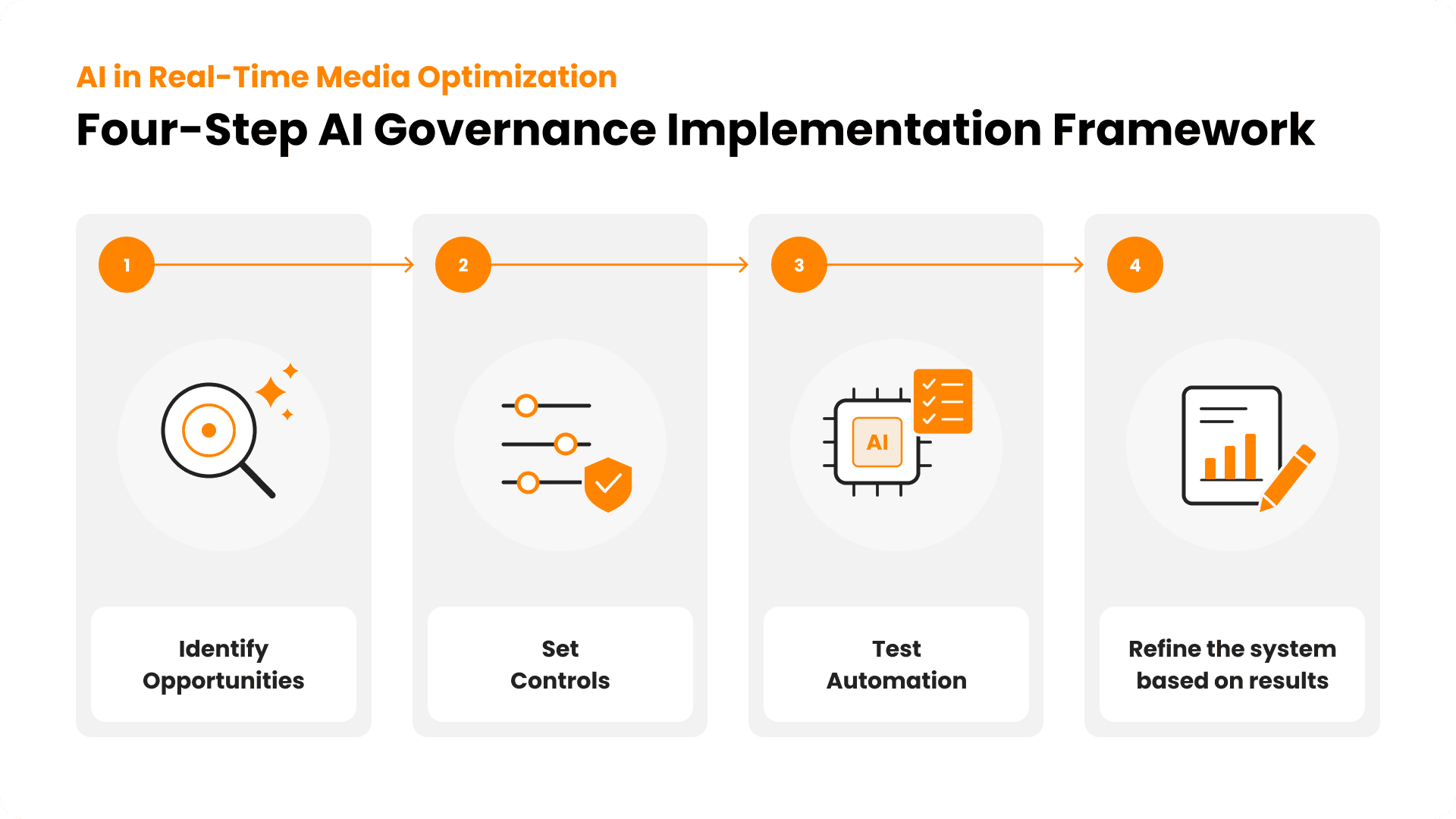
Step 1: Identify High-Value Automation Opportunities
Start by reviewing the campaign decisions that consume the most time or would benefit from a faster response.
Routine bid adjustments, budget pacing, and creative rotation may offer opportunities for automation. Prioritize activities with clear objectives, reliable data, and manageable risk. Avoid starting with decisions that involve major financial commitments or substantial changes in business strategy.
Step 2: Set Decision Rules and Limits
Document what each automated system can change, the limits it should follow, and conditions that require human review. Establish approved budgets, audience restrictions, performance targets, and escalation procedures.
Assign clear owners to each automated process. Teams should also understand what the platform allows them to control and what information is available for monitoring.
Step 3: Test Before Expanding Automation
Begin with a limited number of campaigns or a controlled portion of the media budget. Compare results against an appropriate baseline and evaluate whether automation follows the established rules.
Testing should examine business outcomes as well as operational behavior. For example, did the system respond appropriately to performance changes? Did it stay within budget limits? Were alerts useful and timely?
Where feasible, controlled experiments can help determine whether automated decisions produce better results than the existing approach. Expand automation only after the initial process demonstrates acceptable performance and control.
Step 4: Monitor, Review, and Refine
Governance rules should change as campaign needs, business priorities, and platform capabilities change. Review performance, alerts, exceptions, and human interventions on a regular schedule. Repeated manual overrides may indicate that the system needs better inputs, tighter restrictions, or different approval requirements.
As teams gain confidence in specific automated tasks, they may be able to increase decision authority. When risks increase, they should be prepared to reduce that authority. The goal is to create a process that adapts while maintaining accountability.
How MatrixPoint Helps Brands Govern AI-Driven Media
AI can help media teams respond faster, but speed is only valuable when decisions support the right business outcomes.
MatrixPoint helps brands evaluate how automation fits into their media strategy, identify where oversight is needed, and establish controls that protect budgets and business priorities.
Our approach connects media planning, campaign performance, measurement, and business objectives. This helps advertisers assess where AI can make routine decisions, where human approval remains important, and whether automated changes are producing results.
Through media audits, independent measurement, marketing mix modeling, and strategic consulting, MatrixPoint helps brands understand how media investments contribute to growth and where automated systems may require closer review.
Ready to strengthen your approach to AI-powered media optimization? Contact MatrixPoint to discuss how to put the right governance practices in place, improve oversight, and make faster media decisions with confidence.